Balenciaga’s modern identity sits at the collision point of couture technique and street-level provocation. Oversized proportions, uncanny silhouettes, logo play, and deliberate “wrongness” show up as design tools—often polarizing, frequently imitated, and consistently influential. The visual cues aren’t random: they’re engineered through cut, weight, construction, and context, which is why the brand’s look can feel instantly recognizable across sneakers, outerwear, bags, and runway pieces. For more guidance, see Introducing Cristóbal Balenciaga – V&A.
At its clearest, the Balenciaga vibe is silhouette-first. Proportion becomes the message: exaggerated shoulders, elongated sleeves, ballooned outerwear, and volume that redirects attention away from any “ideal” body outline. Instead of flattering by narrowing, the designs often flatter by asserting shape. For further reading, see Cristóbal Balenciaga: A Timeless Influence on Fashion Evolution.
Another signature is the tension between polish and rawness. A piece can be impeccably cut, yet look worn-in on purpose—distressed hems, scuffed finishes, utilitarian hardware, or intentionally ordinary materials. Everyday objects get elevated too: hoodies, workwear, mall references, and “basic” staples reframed through pattern-cutting, fabrication, and runway context.
The brand also subverts familiarity. Something reads normal at first glance, then becomes strange on a second look: toe shapes that feel off, collars that sit too high, hemlines that land unexpectedly, or scale changes that shift the mood. Finally, graphic identity is used strategically rather than consistently—minimal wordmarks one season, loud logos the next, or near-blank surfaces that let shape do the talking.
| Signal | What it looks like | Why it matters | How to style it without costume |
|---|---|---|---|
| Oversized outerwear | Cocoon coats, padded bombers, dropped shoulders | Creates a protective, architectural silhouette | Keep the base simple: straight jeans or narrow trousers; minimal accessories |
| Chunky footwear | Bulky sneakers/boots, thick soles, wide toe boxes | Anchors the silhouette and adds intentional heaviness | Balance with cropped hems or tapered bottoms so proportions feel deliberate |
| Logo/wordmark play | Bold branding or restrained placement | Signals cultural commentary and recognizability | Use one branded item per outfit; avoid competing graphics |
| High-low mixing | Couture-like cuts with casual items | Turns “ordinary” into a statement through contrast | Pair tailoring with a hoodie or tee; keep color palette tight |
| Intentional distressing | Worn edges, washed dyes, scuffed finishes | Adds narrative and anti-perfection attitude | Let the distressed piece be the focal point; keep everything else clean |
Balenciaga can read like a spectrum. On the streetwear side, the emphasis is on scale, comfort, and instantly recognizable staples—hoodies, tees, denim, sneakers—reshaped through proportion and branding. On the couture side, the tools are structure, fabrication, and pattern mastery: sculptural silhouettes, clean internal construction, and runway-level finishing.
What keeps both ends coherent is that the “shock” is frequently built into the cut and volume rather than printed on the surface. A simple black coat can feel confrontational if its shoulders act like scaffolding, its sleeve length stacks at the wrist, or its hemline changes how the body occupies space.
When comparing pieces, look past the headline styling and check seam placement, shoulder architecture, fabric weight, and whether the garment holds its shape off the body. Those are the quiet cues that separate a merely oversized item from an intentionally engineered one.
Many Balenciaga looks are “constructed” even when they pretend to be casual. Shoulders often function as the frame: extended, rounded, or dropped in ways that change posture and project either power or studied nonchalance. Waist placement is another lever—dropped waists, boxy cuts, and straight torso lines resist hourglass expectations and emphasize shape over body.
Length and drape create a stacked vertical line: extra sleeve length, longer tees, and coat hems that build deliberate layering. Footwear then becomes proportion control—heavy shoes counterbalance volume up top and stabilize oversized looks so they read intentional rather than accidental.
A quick fit checklist helps: well-designed oversized pieces sit clean at the neckline and follow a purposeful shoulder seam logic. They shouldn’t be sloppy everywhere at once.
For deeper brand context, the Met’s overview of Cristóbal Balenciaga, the official Balenciaga site, and Vogue’s Balenciaga runway archive help connect heritage technique to modern provocation.
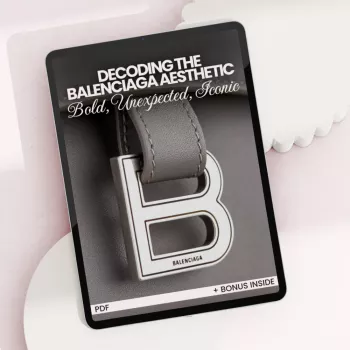
If a repeatable method is more useful than one-off inspiration, Decoding the Balenciaga Aesthetic: Bold, Unexpected, Iconic – Fashion eBook Guide breaks down the defining moves—proportion, silhouette logic, material contrasts, and cultural references—so the aesthetic reads consistently across categories.
For practical use alongside everyday styling and shopping, these in-stock add-ons can help keep looks organized and mobile-ready: Adjustable Foldable Phone Stand for iPhone for hands-free outfit checks or filming, and Magnetic Transparent Case for Apple iPhone 16 Pro Max to keep your device protected while you save references, notes, and fit photos.
It’s silhouette-driven fashion built on exaggeration, irony, and high-low contrast. The focus is on proportion, material tension, and cultural commentary more than consistent logos.
Use one exaggerated item at a time and keep the rest streamlined. Heavier footwear can balance proportions, and a disciplined neutral palette makes the shape feel intentional instead of loud.
It sits on a spectrum: streetwear references executed with couture-level pattern ideas. The same design codes—scale, engineered silhouette, and controlled “wrongness”—show up in both casual and formal pieces.










Leave a comment